
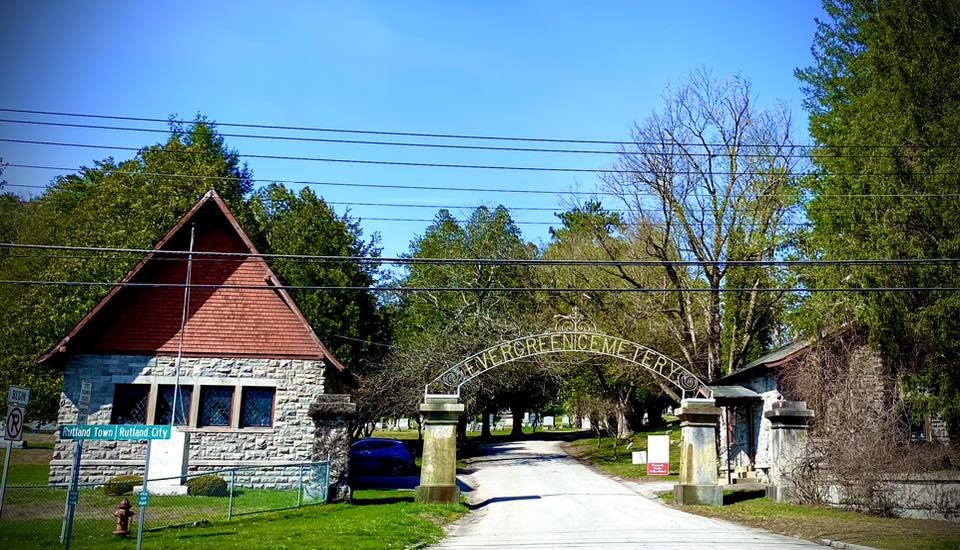
On February 5, 2026, Evergreen Cemetery in Rutland, Vermont announced a partnership that will transform how it preserves over 160 years of American history. The cemetery’s approximately 15,000 graves—including six Vermont governors, Civil War heroes, and countless family stories—will be photographed, GPS-mapped, and made searchable worldwide through TAFOFILE.COM. The cost: zero. For a cemetery that had been quoted $40,000 by a commercial mapping company, the free platform makes comprehensive digitization possible for the first time. The collaboration represents a fundamental shift in cemetery preservation: community volunteers with cell phones and AI-powered transcription accomplishing what commercial contractors charge five figures to provide.
A Cemetery with Deep Roots in Vermont History
Evergreen Cemetery’s story begins in 1861, when it was established as Pine Hill Cemetery. The burial ground was dedicated on October 16, 1861, during the first year of the Civil War, with William A. Burnett serving as its first superintendent (O’Connor 2024). The cemetery took its name from Rutland’s Pine Hill, where the original 45-acre site was constructed on wooded knolls that offered visitors what the Rutland Herald described as a visit that “cannot fail to gratify” (O’Connor 2024). The name was changed to Evergreen Cemetery in 1862, reflecting a broader vision for the sacred ground.
The cemetery’s initial construction included elegant features befitting its era: marble walkways, a vault, a front wall, and a marble gateway. Seven fountains were installed across the grounds, one of which, located in Section C, continues to flow today—a testament to the craftsmanship of the 19th century (O’Connor 2024). Over the decades, Evergreen expanded through purchases and donations, eventually encompassing approximately 75 wooded acres at 465 West Street in Rutland City, near the border with Rutland town.
The grounds hold the remains of some of Vermont’s most distinguished citizens. Six Vermont governors rest here: Percival Clement, John Mead, John Page, Charles Manley Smith, Robert Stafford, and Charles K. Williams. U.S. Senator Solomon Foot, who served as the Senate’s president pro tempore during the Civil War, is buried alongside U.S. Representatives George Tisdale Hodges and Charles Herbert Joyce (WCAX 2024). The cemetery also honors Civil War heroes, including Colonel William T. Nichols, who led the 14th Vermont Volunteer Infantry in repelling Pickett’s Charge at the Battle of Gettysburg. Perhaps the most recognized name today is that of Governor and U.S. Senator Robert Stafford, for whom the federal student loan program was named (O’Connor 2024).
From Crisis to Empowerment
The journey to this partnership was born from challenge, but the story is one of community resilience rather than defeat. Like many historic cemeteries across America, Evergreen faced significant financial pressures in recent years. The shift toward cremation has dramatically reduced revenues from traditional full-body burials, which had fallen by two-thirds in recent years (Rutland Herald 2024). In March 2024, the previous board of trustees announced plans to cease operations on April 26, citing an inability to meet the annual minimum of $120,000 needed for staffing and cemetery maintenance.
The announcement sent shockwaves through the community. “It was a shock to everyone,” recalled Don Adams Jr., who would become president of a reconstituted board. “They threw up a white flag” (Mountain Times 2024). But the lot owners and community members refused to let their heritage disappear. On May 22, 2024, in a meeting authorized by the cemetery’s original 1860 bylaws, 75 current lot owners gathered outside the gatehouse to dissolve the original board and elect provisional officers.
This grassroots action saved Evergreen Cemetery from abandonment and set the stage for innovative thinking about preservation. Adams and his fellow trustees, including Thomas Giffin—Rutland’s cemetery commissioner and president of the Vermont Old Cemetery Association—brought fresh energy and a willingness to explore modern solutions (WCAX 2024).
The Cost of Preservation: A National Challenge
The financial realities facing Evergreen Cemetery are in no way dissimilar to those affecting a long list of aging cemeteries nationwide. When cemeteries seek to digitize their records and create interactive maps, they often encounter staggering price quotes. Cemetery mapping and digitization services typically involve ground-penetrating radar surveys, GPS coordinate collection, database creation, and web platform development. These comprehensive projects can easily reach tens of thousands of dollars.
The previous Evergreen board had explored creating a database of cemetery deeds, hoping it would provide both better service and potential revenue. One vendor initially estimated $10,000 for this work, but the price later escalated to $23,000—funds the struggling cemetery simply could not spare (Rutland Herald 2024). According to the new board’s February 2026 announcement, a cemetery mapping company had quoted them $40,000 for comprehensive digitization services.
This pricing structure creates a cruel irony: the cemeteries most in need of digital preservation—those with limited resources, aging infrastructure, and incomplete records—are often the ones least able to afford modern solutions. Historic rural cemeteries, small-town burial grounds, and financially struggling associations face the choice between maintaining their physical grounds or investing in digital preservation. Too often, both suffer.
A Different Approach: Memorial-Centric Preservation
TAFOFILE’s partnership with Evergreen Cemetery represents a fundamentally different philosophy about cemetery documentation. Unlike commercial services that charge based on cemetery size or number of graves, TAFOFILE operates as a free platform with a mission-driven purpose: to preserve cemetery records and create lasting memorials before time, weather, and neglect erase them forever.
The platform’s approach centers on memorialization rather than mere record-keeping. Every grave documented on TAFOFILE becomes a living memorial page where families can share memories, upload photographs, and tell the stories of their loved ones. GPS coordinates captured during documentation allow anyone in the world to locate specific graves and, crucially, navigate directly to them when visiting the cemetery. This transforms scattered records into an interconnected web of family history and community heritage.
The technology behind TAFOFILE leverages artificial intelligence to transcribe headstone inscriptions and cemetery documents, dramatically reducing the time required for documentation while maintaining accuracy. Volunteers can photograph headstones with their smartphones, and the platform automatically captures GPS coordinates, processes the images, and creates memorial pages. This crowdsourced approach allows a community working together to accomplish comprehensive documentation that would be overwhelming for any single individual or small team.
For Evergreen Cemetery, this means approximately 15,000 graves will be photographed by volunteers, each receiving GPS coordinates that will be permanently linked to cemetery records. Families separated by distance or time from their ancestral burial grounds will be able to search the TAFOFILE database, find their relatives, see photographs of headstones, read transcribed inscriptions, and receive directions to exact grave locations. The platform becomes not just a database, but a bridge connecting the living to those who came before.
The comprehensive documentation also provides cemetery managers with critical operational data. The platform allows volunteers to submit notes on the cleanliness and condition of each headstone during documentation, creating a detailed assessment that helps the board prioritize maintenance needs—identifying stones requiring cleaning, repair, or stabilization. This visual inventory combined with condition reporting streamlines planning for restoration projects and helps target limited resources where they are most needed. Additionally, the detailed records and condition documentation that TAFOFILE generates can strengthen grant applications, providing the data and evidence that funding organizations require. For a cemetery operating on tight budgets, this information becomes invaluable for securing preservation grants and demonstrating stewardship to potential donors.
The Power of Community Action
The official announcement from the Evergreen Cemetery board on February 5 laid out the ambitious scope of the project and the community participation it would require. In a message to lot owners and descendants, board administrator Frank Vasos Jr. made the financial contrast starkly clear: “Thanks to Tafofile, our cost for this instead will be $0. Wisely investing the money that many of you have generously donated to help us carry forward.”
But the free platform came with one essential requirement. As Vasos explained, “There is only one catch to this zero-cost solution: We need your personal help to complete this project. Not just ten or twenty of the most dedicated volunteers…but everyone!” He characterized this as a “boots on the ground” project where success depends entirely on community participation.
The call to action was direct: volunteers with smartphones would photograph headstones across the cemetery’s 15,000 graves, with the platform automatically capturing GPS coordinates and using AI to transcribe inscriptions.
Beyond Photography: Digitizing Historical Records
The partnership extends beyond field documentation to include the digitization of burial records held by Evergreen Cemetery. These records contain information that may not appear on any headstone—burial dates, plot locations, family relationships, and other vital details. The platform’s AI recognizes handwritten names and dates, matching them to existing memorial pages uploaded from headstone photographs. This creates a comprehensive digital archive where official records and physical memorials connect seamlessly.
Additionally, TAFOFILE allows families to enrich their ancestors’ memorial pages by uploading genealogical and historical documents—photographs, personal correspondence, military records, obituaries, and family memorabilia. This transforms each memorial from a simple record into a rich repository of family history, preserving materials that might otherwise be lost or scattered across different family members.
For genealogists and family historians, this integration creates a comprehensive resource where official records, physical memorials, and family documents connect seamlessly in one searchable platform. The document digitization work can proceed independently of field photography, allowing volunteers to contribute according to their interests and availability.
A Model for Cemeteries Everywhere
The Evergreen Cemetery partnership with TAFOFILE arrives at a critical moment for historic preservation. Across America, countless burial grounds face similar challenges: declining revenues, deferred maintenance, incomplete records, and the slow march of time eroding both physical markers and institutional memory. Many cemetery associations, particularly smaller ones, operate with skeleton crews or entirely through volunteers. For these organizations, a $40,000 digitization project is not just expensive—it is utterly out of reach.
TAFOFILE’s free model removes this barrier entirely. Whether a rural cemetery with 500 graves, a historic African American burial ground documenting enslaved ancestors, or a pioneer cemetery maintained by a local historical society, the cost remains zero. The platform democratizes preservation, ensuring that financial resources do not determine which communities can maintain connections with their heritage.
This model also acknowledges a fundamental truth about cemetery documentation: the people who care most deeply about preservation are often the families, volunteers, and community members who have personal connections to the burial ground. By making the platform free and accessible, TAFOFILE empowers these stakeholders to take action themselves rather than waiting for outside organizations or government agencies to provide assistance that may never come.
The impact extends beyond individual cemeteries. As more burial grounds join TAFOFILE, the platform becomes an international repository of genealogical information and family history. Researchers can search across multiple cemeteries, trace families’ movements through different communities, and discover connections between seemingly disparate communities. Every documented cemetery adds to this growing network of memorial preservation.
The Role of Volunteers in Modern Preservation
The Evergreen Cemetery project demonstrates how community volunteers, equipped with just their cell phones, can accomplish preservation work that would traditionally require professional surveying crews and specialized equipment. This volunteer-driven approach has several advantages beyond cost savings. Local residents often possess knowledge about the cemetery that outsiders lack—they remember which families are buried in which sections, can identify unmarked graves based on oral history, and understand the cultural and historical context of the burial ground.
Volunteers also develop personal investment in the project’s success. When community members spend hours photographing headstones, transcribing inscriptions, and organizing records, they forge deeper connections to their local heritage. The cemetery transforms from a passive landscape into an active site of historical engagement. This grassroots involvement often sparks broader interest in cemetery maintenance, historical preservation, and genealogical research within the community.
The Vermont Old Cemetery Association, led by Thomas Giffin, has demonstrated the power of volunteer action through restoration projects across the state. In June 2025, approximately 60 GE Aerospace employees and VOCA members gathered at Evergreen Cemetery to restore dozens of graves, cleaning headstones and leveling markers that had been neglected for years (MyNBC5 2025). These volunteers understood that preservation is an ongoing commitment, not a one-time project. Digital documentation complements physical maintenance, ensuring that even if a headstone eventually succumbs to weather and time, its information survives in digital form.
Looking Forward: A Sustainable Future for Evergreen
The partnership between Evergreen Cemetery and TAFOFILE offers a roadmap for sustainable cemetery documentation in the 21st century. By eliminating the massive upfront costs of digitization and relying on community engagement for documentation, the cemetery can focus its limited financial resources on essential physical maintenance: mowing, grave digging, infrastructure repair, and office operations. The digital preservation work proceeds in parallel, carried forward by volunteers who contribute according to their availability and interest.
This model also creates ongoing value rather than a static database. As families visit the cemetery and access memorial pages on TAFOFILE, they can add their own photographs, share stories, and update information. The platform becomes a living archive that grows richer over time. Genealogists worldwide can contribute knowledge about individuals buried at Evergreen, connecting Vermont history to broader family networks across the country and internationally.
The cemetery that nearly closed its gates in 2024 now embarks on one of the most comprehensive documentation projects in its 164-year history. Every grave will be photographed. Every record will be digitized. Every name will be searchable. Every family will have the ability to find and honor their ancestors.
A New Model for Preservation
When faced with costs that were completely out of reach, Evergreen’s board found a partner whose mission aligned with their own. TAFOFILE was built on a fundamental principle: cemetery preservation should not be a luxury affordable only to well-funded institutions. Every cemetery deserves the tools to document its history, every family deserves access to their ancestors’ final resting places, and every community deserves the opportunity to preserve its heritage before time erases it.
This partnership offers a blueprint for cemeteries nationwide facing similar challenges. The tools exist, the technology works, and the cost is zero. As volunteers prepare to begin their documentation work when spring weather arrives, they will be preserving the legacy of Vermont governors, Civil War heroes, and ordinary citizens whose collective stories form the fabric of American history. The partnership honors those buried at Evergreen—from Senator Solomon Foot to the unmarked graves of those whose names may be lost—by ensuring their memorial locations will remain accessible to anyone, anywhere, forever.
From the brink of closure to comprehensive digital preservation, Evergreen Cemetery’s transformation demonstrates what becomes possible when technology serves community rather than profit. Graves that nearly lost their steward in 2024 will now be documented, mapped, and made searchable for families worldwide—not despite limited resources, but because a free platform and committed volunteers proved that preservation belongs to everyone. In Rutland, Vermont, a 164-year-old cemetery is writing a new chapter in its history, one photograph at a time.
References
Mountain Times. 2024. “They Threw Up A White Flag.” July 17, 2024. https://mountaintimes.info/2024/07/17/they-threw-up-a-white-flag/
MyNBC5. 2025. “Volunteers Help to Restore Graves at Historic Cemetery in Rutland.” June 5, 2025. https://www.mynbc5.com/article/volunteers-help-to-restore-graves-at-historic-cemetery-in-rutland-vt/64984061
O’Connor, Kevin. 2024. “Can a Cemetery Die? With Last-Minute Resuscitation, Rutland’s Largest Finds New Life.” VTDigger, May 27, 2024. https://vtdigger.org/2024/05/27/can-a-cemetery-die-with-last-minute-resuscitation-rutlands-largest-finds-new-life/
Rutland Herald. 2024. “Rutland’s Evergreen Cemetery to Cease Operations.” March 21, 2024. https://www.rutlandherald.com/news/local/rutlands-evergreen-cemetery-to-cease-operations/article_1f38f770-72eb-599c-82f3-1ffc05e08e61.html
WCAX. 2024. “Financially Strapped Rutland Cemetery Will Remain Open.” June 13, 2024. https://www.wcax.com/2024/06/13/financially-strapped-rutland-cemetery-will-remain-open/